
Worksheets get a bad rap.
Sometimes, deservedly so. A stack of questions, a pencil, and the instruction "Complete the worksheet" isn't exactly a recipe for high-energy student engagement.
But here’s the thing: the worksheet itself might not be the problem.
Sometimes students just need a different way to interact with it.
You can take almost any standard worksheet and instantly transform it into a high-engagement, analog board game using three simple items you probably already have in your classroom:
- Paper (the printable game board)
- Dice (a simple 6-sided die per group)
- Counters (erasers, coins, LEGO figures, or plastic game pieces)
No elaborate prep. No complicated edtech tools to set up. No hours spent designing a custom game from scratch. Just take the questions you already have and inject a little movement, competition, choice, and chance.
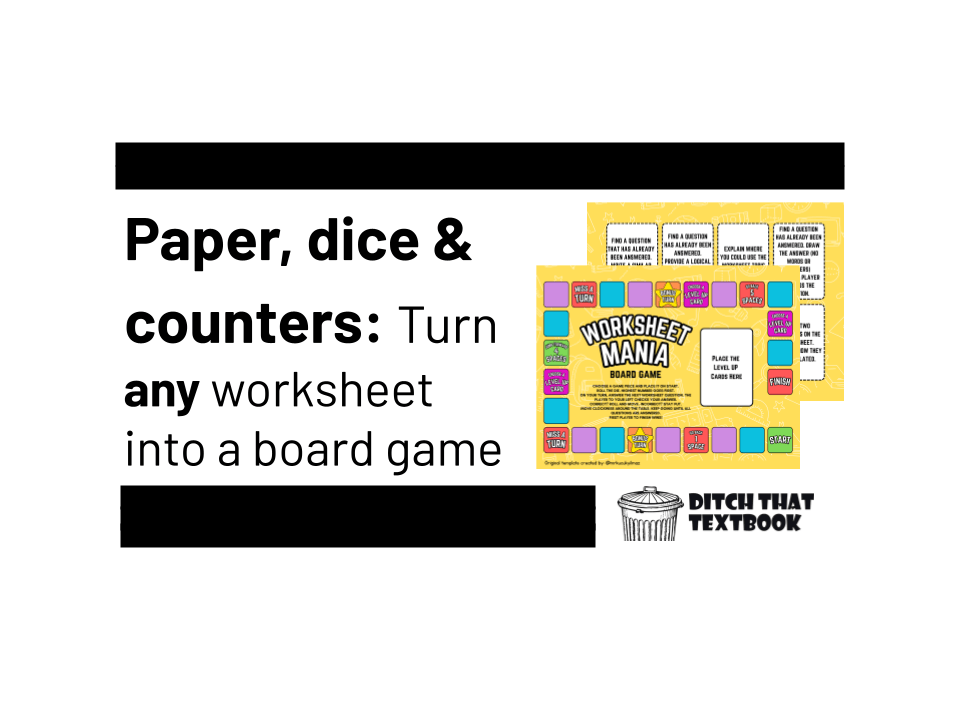
Welcome to Worksheet Mania.
The worksheet stays. The experience changes.
Imagine you've assigned a worksheet with 20 questions.
Normally, students work silently from #1 to #20. Maybe they work independently. Maybe they finish early and sit there staring at the clock while others struggle to keep up.
Now, picture this instead:
- Divide students into groups of three or four.
- Give each group one game board and a die, and give every player a game piece.
- Place the game board and worksheet in the middle of the table.
Students work through the same worksheet together, but now every correct answer gives them a chance to roll and move around the board. Suddenly, there's an immediate reason to care about accuracy.

Because everyone is interacting with the exact same content, you haven't had to create a brand-new activity. You've simply changed the way students experience the content.
How the game works
The gameplay rules are intentionally simple so students can dive right in:
- Setup: Every student gets a copy of the worksheet. Each group gets one game board, one die, and game pieces placed on START.
- Player Order: Everyone rolls the die; the highest roll goes first, and play moves clockwise.
- Gameplay Loop: On your turn, answer the next unanswered question on the worksheet. The player to your left checks your answer.
- Correct? Roll the die and move forward that many spaces.
- Incorrect? Stay where you are.
- Winning Condition: Keep moving through the worksheet until all questions are answered. The first player to cross the FINISH line wins!
Not every space is created equal
If every correct answer simply meant "roll and move," the game would work—but adding a few surprises makes it far more engaging.
The Worksheet Mania board includes dynamic action spaces:
- Jump forward 4 spaces
- Go back 1 space or go back 5 spaces
- Miss a turn
- Bonus turn (roll and move immediately again)
These spaces introduce a healthy dose of randomness. A student who is lagging behind can suddenly catch up, while a student cruising toward the finish line might draw a setback space.
Why this matters: The winner isn't necessarily the student who finishes fastest. By balancing content accuracy with game chance, all students remain invested in every turn.
Level up cards: Shifting higher up Bloom's Taxonomy
This is where the strategy moves from simple practice to deep learning.
Landing on a "CHOOSE A LEVEL UP CARD" space pauses the standard question-and-answer loop. Instead of just solving the next problem, the card requires students to rethink, explain, create, draw, act, or connect with questions already on the page.
You may choose to assign something fun to go along with the level up cards such as "move an extra three spaces" or "swap places with another player".
Here are the Level Up Card prompts from the game board and how they elevate student thinking:
Level Up Prompt PDF | Cognitive Shift | Why It Works |
"Find a question that has already been answered. Write a similar question for the group to answer." | Creating & Synthesizing | Moves students from answering questions to generating original items based on the same pattern. |
"Find a question that has already been answered. Provide a logical question that could have that same answer." | Reverse Engineering | Forces students to analyze the structural relationship between prompts and solutions. |
"Explain where you could use the worksheet topic in real life." | Real-World Application | Bridges the gap between abstract classroom practice and real-world relevance. |
"Choose a new question. Write 4 multiple choice answers for it. Give the rest of the group your quiz question." | Evaluation & Assessment | To write compelling distractors (wrong choices), students must anticipate common misconceptions. |
"Find a question that has already been answered. Create a wrong answer that a classmate might choose. Explain why it's wrong." | Error Analysis | Destigmatizes mistakes by transforming common errors into explicit learning opportunities. |
"Find two questions on the worksheet. Explain how they are related." | Making Connections | Encourages big-picture thinking across the entire page rather than treating items in isolation. |
Get students off the page (draw and act)
Some Level Up Cards deliberately get students away from their pencils:
The Drawing Challenge: "Find a question that has already been answered. Draw the answer (no words or numbers). Choose a player to guess the question."
The Charades Challenge: "Find a question that has already been answered. Act out the answer (no talking). Everyone else has to guess the question."
Picture a typical classroom table group during this moment:
Five minutes ago, they were quietly filling out a worksheet. Now, a student is standing beside the table silently acting out a chemical reaction, a historical event, a vocabulary word, or a math concept while their group tries to guess which question it matches.
The academic content hasn't changed—the interaction has.
Plug-and-play across all subject areas
Because the game framework relies on whatever text or math problems you provide, you can use it across any content area:
Math: Convert a standard review page into a high-stakes board race.
Science: Turn a study guide into a drawing and charades challenge.
ELA & Vocab: Transform vocabulary practice into a choice-driven creation board.
Social Studies: Use unit reviews to let students write test questions for one another.
Make it your own: Remixing the rules
Once your students understand the core mechanics, adapt the rules to fit your lesson goals:
Speed Round: Correct answers earn two dice rolls, and the player picks the higher value.
Explanation Required: Players must verbally explain their reasoning to the group before rolling.
Co-Op Mode: The entire table group plays together against a countdown timer.
Custom Cards: Create your own set of Level Up prompts tailored to specific unit standards.
Try it with your next worksheet
The next time you're about to pass out a standard practice sheet, pause for a moment. You don't need to rewrite your curriculum. You don't need to spend hours building a digital game or creating complex rules.
Grab a game board, print a handful of Level Up cards, hand out a die and a few counters, and place the worksheet at the center of a shared experience. Sometimes you don't need to ditch the worksheet. You just need to add a game!
